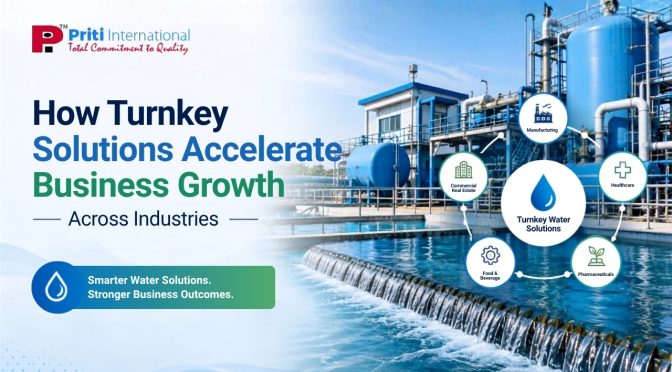
How Turnkey Solutions Accelerate Business Growth Across Industries

When most people hear “turnkey,” they think convenience — one vendor, less hassle, fewer phone calls. That’s true, but it badly undersells the point. Convenience doesn’t grow a business. What actually moves the needle is something turnkey delivers as a by-product: it shortens the distance between your investment and your first rupee of revenue.
For any new plant or production line, the clock starts the day you commit capital and doesn’t stop until you’re selling a product. Every week in between is money spent with nothing coming back. Turnkey project execution exists to compress that gap. Understanding how it does that — and where it can go wrong — is the difference between a smart engagement and an expensive one.

What “Turnkey” Actually Means

A turnkey solution means a single partner takes a project from concept to commissioning and hands you a running operation — you “turn the key” and produce. That partner owns the design, machinery selection, civil and utility coordination, installation, licensing support, trial runs and final handover.
The opposite is self-assembly: you hire a machinery supplier here, a civil contractor there, a licensing consultant somewhere else, and you become the project manager stitching them together. That can work — but you absorb every coordination gap, every “that’s not my scope” dispute, and every delay that cascades when one vendor slips. Turnkey moves that burden off your desk and onto one accountable party.

The Real Growth Lever: Compressing Time-To-Revenue

Here’s the mechanism, stripped of marketing language. Turnkey accelerates growth through four concrete levers:
Speed- Parallel execution. A turnkey team sequences civil work, machinery procurement and licensing to overlap rather than queue, which can cut months off a launch. Months saved are months of earlier production and earlier cash flow.
Single accountability- When one partner owns the outcome, there’s no finger-pointing when something breaks. You have one number to call and one entity contractually responsible for the plant working. That’s not just convenient — it removes the project-management overhead that quietly drains a founder’s time and attention away from sales and strategy.
Capital efficiency- A good turnkey partner sizes the plant to your actual market and budget, not to an optimistic template. Right-sizing avoids the two classic mistakes — over-building capacity you can’t sell, or under-building and being forced into a costly retrofit within a year.
Faster compliance- Across regulated industries — food, beverage, water — licensing is often the hidden bottleneck. FSSAI, BIS, Pollution Control Board, GST and local approvals each have their own timelines. A partner who has navigated them before clears that path far faster than a first-timer learning it live.
Add these up and the value isn’t “we saved you hassle.” It’s “we got you to market a quarter sooner, with less capital tied up.” That compounds.

Turnkey Across Industries – What It Looks Like in Practice

The phrase “across industries” only means something when it’s concrete. Here’s how the same turnkey discipline plays out in three very different verticals.
Food processing. Abiscuit and bakery plant needs mixing, forming, baking, cooling and packaging lines synchronised to a single throughput, plus FSSAI-compliant hygienic design. Get the line balance wrong and you have a fast oven feeding a slow packer — bottlenecks that bleed margin every shift. Turnkey design solves for the whole line, not isolated machines.
Beverages. Afruit juice plant or amineral and packaged water plant combines treatment, processing, filling and packaging under strict quality and shelf-life requirements. Here the turnkey partner’s job is integrating purification, filling accuracy and compliance into one validated process — because a beverage line is only as good as its weakest hygienic link.
Water and environment.RO, ETP, STP and DM plants are engineered around your specific water or effluent profile and your Pollution Control Board consent conditions. There’s no off-the-shelf answer; the design is the value. Turnkey execution here means the system is built to pass audits from day one, not patched into compliance after a notice arrives.
Different industries, same principle: integrate the whole system around your outcome, and own the result end to end.

The Catch Nobody Puts in The Brochure

Turnkey concentrates your risk in one vendor. That’s the honest trade-off, and pretending otherwise does you no favors. If you pick the wrong partner, you’ve handed a single point of failure control over your entire project — and switching mid-stream is painful and expensive.
This isn’t a reason to avoid turnkey. It’s a reason to choose the partner carefully, because the model amplifies whatever you select. De-risk it by checking three things before you sign: a track record of commissioned plants in your specific industry (not just brochures), transparent scope boundaries in writing so “turnkey” doesn’t quietly exclude licensing or trial runs, and post-handover support — because a plant that runs on day one but has no service backing is a liability waiting to surface.
A serious turnkey partner welcomes those questions. A weak one deflects them.

Why Kolkata Businesses Choose Turnkey Project Solutions

For entrepreneurs in the East, turnkey project solutions in Kolkata offer a specific advantage: a local partner who understands regional licensing, the West Bengal Pollution Control Board’s expectations, local supply chains and ground realities that a distant national vendor simply doesn’t. Proximity also matters after handover — when a line needs servicing, a partner an hour away beats one a flight away.
This is the core of what Priti International does. We deliver complete turnkey projects across food processing, beverage and water-treatment industries — from initial costing and machinery selection through installation, licensing and commissioning — built around your market, your budget and your compliance requirements. If you’re weighing a new plant and want a partner who’ll tell you what you actually need before recommending equipment,start a conversation with our team.

FAQ

Is turnkey more expensive than managing it myself?
Often the headline quote looks higher, but it usually costs less in total once you account for coordination delays, retrofit risk and your own time. The real saving is faster time-to-revenue.
Which industries suit turnkey project solutions?
Any project with multiple interdependent systems and regulatory steps — food processing, beverages, packaged and mineral water, and water/effluent treatment are all strong fits.
How do I choose a turnkey partner in Kolkata?
Look for commissioned projects in your specific industry, written scope clarity, and genuine post-handover support. Local regulatory familiarity is a real advantage in West Bengal.
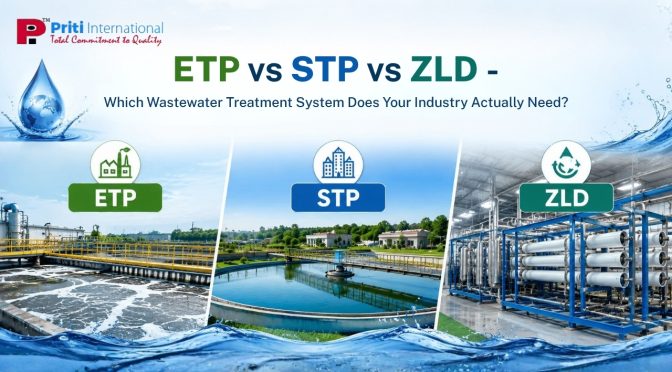
ETP vs STP vs ZLD – Which Wastewater Treatment System Does Your Industry Actually Need?

Most businesses ask this question the wrong way. They treat ETP, STP and ZLD as three competing products and assume the job is to pick the best one. It isn’t. These three aren’t rivals on a shortlist — they do different jobs, and many industrial sites are legally required to run more than one of them at the same time.
So the useful question isn’t “which is best?” It’s “which combination does my Pollution Control Board consent actually demand?” Here’s how to answer that clearly.

The 30-Second Difference

STP — Sewage Treatment Plant. Treats domestic wastewater: toilets, kitchens, washrooms, canteens. The pollutants are organic — human waste, food matter, detergents. Any facility with people generates sewage, so offices, hotels, hospitals, housing societies and factory washrooms all produce it.
ETP — Effluent Treatment Plant. Treats industrial wastewater from your manufacturing process — chemicals, dyes, oils, heavy metals, high COD and TDS. This is the dangerous stream, and it varies wildly by industry. A dairy’s effluent looks nothing like a tannery’s.
ZLD — Zero Liquid Discharge. Not a separate “plant” so much as an outcome. ZLD is an advanced stage bolted onto an ETP that recovers up to 95% of your water and discharges nothing liquid at all, leaving only solid salts. It uses RO, evaporators and crystallisers to close the loop.
The key insight: STP and ETP are defined by what they treat. ZLD is defined by how completely you treat it. That’s why “ETP vs ZLD” is a false comparison — ZLD sits on top of an ETP, it doesn’t replace it.

Why Most Sites Need a Combination

A textile dyeing unit is the clearest example. Its workers use washrooms (needs an STP), its dyeing baths produce chemical effluent (needs an ETP), and because dyeing is a red-category, high-pollution activity, the regulator mandates ZLD on top. That’s all three — not a choice between them.
This is the trap behind the “vs” framing. Pick only one when your consent requires two, and you face the real consequences: rejected Consent to Operate, daily penalties, and in serious cases a forced shutdown. The system you “need” is whatever keeps your CTO valid — and that’s decided by the Pollution Control Board, not by preference.

Which Does Your Industry Actually Need?

Here’s a practical mapping. Confirm specifics with your State Pollution Control Board, since norms vary by state and location.
You mainly need an STP if: you run a commercial building, IT park, hotel, hospital, school or residential township, and your wastewater is essentially domestic. Increasingly, new projects of almost any kind must show an STP and a water-reuse plan just to get environmental clearance — so even non-industrial developments are now in scope.
You need an ETP if: you run any manufacturing that discharges process wastewater — food and dairy, beverages, chemicals, pharmaceuticals, textiles, engineering, electroplating, automobile units. The design depends entirely on your effluent profile; a food plant needs biological treatment, while an electroplating unit needs heavy-metal precipitation. Installing a compliant ETP typically runs ₹10–50 lakh depending on flow volume and industry type.
You need ETP + ZLD if: you fall into a sector the CPCB has flagged for zero discharge — textile dyeing, tanneries, distilleries, pulp & paper, and several pharmaceutical and chemical clusters. ZLD is not a blanket rule for all industries, but for these red-category sectors it’s moving from “recommended” to non-negotiable. Distilleries face especially strict rules: spent wash has extremely high BOD, and direct discharge is prohibited regardless of dilution.
If you’re a low-pollution industry not on the ZLD list, a well-designed conventional ETP is usually sufficient. Don’t let anyone upsell you a ₹2-crore evaporator you aren’t required to run.

What ZLD Really Costs – And Why It’s Not Just a Burden

ZLD is the expensive one: typically four to five times the cost of conventional treatment, with payback usually in the 3–5 year range. That sounds painful until you weigh what it returns. A ZLD plant recovers most of your process water, which is a genuine water-security asset in scarce regions; it produces recoverable salts that can sometimes be sold; and crucially, it gives you regulatory peace of mind plus a “green” credential that EU and US buyers increasingly demand in supply-chain audits.
The 2026 direction is unambiguous. New CPCB effluent norms have tightened BOD, COD and TSS limits, online monitoring (OCEMS) is mandatory for red-category units, and frameworks like the Draft Liquid Waste Management Rules and Extended User Responsibility are pushing bulk water users toward water neutrality. ZLD is the most direct route to that status.
One costly mistake to avoid: feeding raw ETP output straight into an RO unit. Conventional ETP effluent shreds RO membranes, which is where many ZLD projects quietly fail or become unaffordable to run. Stream segregation — treating low-TDS water cheaply and reserving expensive thermal evaporation for the concentrated 30% — is what keeps ZLD economics sane. Good design here saves more money than any single piece of equipment.

Choosing the Right ETP Plant Manufacturer

This is where the decision is won or lost. The biggest reason treatment projects fail isn’t regulation — it’s poor design data. A serious ETP plant manufacturer won’t quote you a system from a single grab sample; they’ll run a proper effluent audit, design around your actual ion profile and flow, and size the plant to your CTO conditions rather than a generic template.
At Priti International, we engineer and install ETP, STP, ZLD, RO and DM plants across Kolkata and Eastern India — built around your specific effluent, your industry’s CPCB norms, and your consent requirements. If you’re unsure which combination your site actually needs, that’s exactly the question we’ll answer before recommending a single piece of equipment.Explore our ETP, STP, ZLD & RO solutions ortalk to our team for a site-specific assessment.

FAQ

Can one plant handle both sewage and industrial effluent?
No. Domestic sewage and industrial effluent have different pollutant profiles and usually require separate STP and ETP systems, though both can sit within one facility.
Is ZLD mandatory for my industry?
Only for specific high-pollution sectors flagged by the CPCB/SPCB — textiles dyeing, tanneries, distilleries, pulp & paper and parts of pharma. Many industries comply fully with a conventional ETP. Confirm with your State board.
How much does an ETP cost?
Roughly ₹10–50 lakh depending on flow volume, industry and effluent complexity. A site-specific audit gives a real figure.

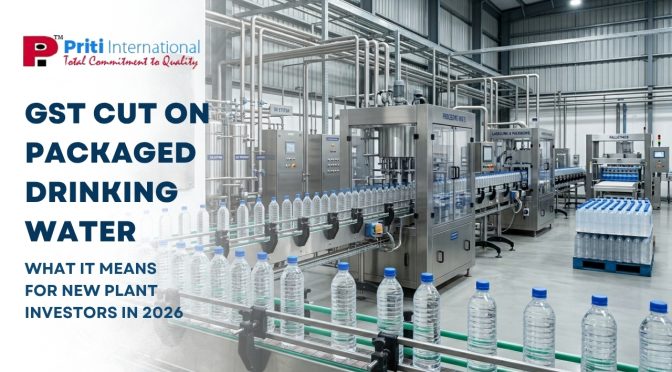
GST Cut on Packaged Drinking Water — What It Means for New Plant Investors in 2026

In September 2025, the GST Council did something that made headlines for consumers: it cut the tax on packaged drinking water. Cheaper water cans, lower bottle prices, relief for households and offices. If you’re thinking about setting up a plant, the obvious takeaway is “lower tax, great time to invest.”
It isn’t that simple and the difference between the simple version and the real version is exactly what separates investors who plan their cash flow from those who get surprised by it. This guide walks through what actually changed, the one consequence most articles skip, whether 2026 is a sensible time to enter, and a grounded breakdown of packaged water plant cost in India.

What Actually Changed in the GST on Packaged Water

Effective 22 September 2025, the GST Council’s 56th meeting cut the rate on packaged drinking water including 1-litre bottles and 20-litre jars from 12%/18% down to 5%, under HSN chapter 2201/2202. Plain, unbranded, unsealed water remains exempt (0%). At the same time, carbonated, aerated, flavoured and energy drinks were pushed up to 40% as “sin goods.”
One caveat worth stating plainly, because the trade press is not fully consistent on it: the clean 5% applies to plain packaged drinking water and 20-litre jars. “Mineral water” with added minerals, and anything carbonated or flavoured, can fall under different classifications and higher rates. Before you fix your pricing, confirm your exact HSN classification with a GST practitioner — getting this wrong on invoices is a common, avoidable compliance headache.

The Part Most “good news” Articles Leave Out

Here is the consequence that rarely makes it into the celebratory coverage, and the single most important thing for a manufacturer to understand:
Your output is now taxed at 5%, but most of your inputs are still taxed at 18%.
Plant and machinery, RO and filtration systems, PET preforms, caps, labels, electricity, maintenance services these largely carry 18% GST. You pay that tax up front and accumulate it as Input Tax Credit (ITC). You then offset ITC against the GST you collect on sales. When your sales GST is only 5%, you simply cannot absorb all the credit you’ve paid. The result is an inverted duty structure: credit piles up faster than you can use it.
That credit isn’t lost; you can claim a refund of accumulated ITC under Section 54(3) of the CGST Act. But refunds take time and paperwork, which means the cut quietly converts into a working-capital drag, not a windfall. For a new plant already managing setup costs, that timing matters.
This is not a reason to avoid the business. It’s a reason to model your numbers properly before you commit. A consumer GST cut and a manufacturer GST cut are different events; this one is firmly the former.

So is 2026 Actually a Good Time to Set Up a Plant?

On balance, yes — but for demand reasons, not tax reasons.
India’s bottled water market is large and growing fast: industry estimates put it at roughly $8.3 billion in 2025, heading toward $13–14 billion by 2030, expanding around 10% a year. The drivers are structural — urbanisation, falling groundwater quality, health awareness, and a hospitality and travel sector that keeps expanding. Established players serve the bulk of the market, but new entrants consistently find room in local supply, institutional bulk water, and niche segments like premium or eco-packaged water. Reported gross margins commonly sit in the 20–40% range for well-run operations, with payback typically in the 2–4 year window.
The lower 5% rate does help on the demand side: a lower tax-inclusive price makes packaged water more affordable and nudges volume, especially for bulk 20-litre supply to offices, schools and institutions. So the cut is genuinely positive — it just works through your sales line, not your tax savings.

Packaged Water Plant Cost in India: What You’ll Actually Spend

The honest answer to “what does a packaged water plant cost in India” is: it depends almost entirely on capacity and automation. Here are realistic 2025–26 industry ranges to anchor your planning.

Plant scale

Capacity

Indicative total setup cost

Micro / starter (RO only) 250–500 LPH ₹1.5 – ₹3.5 lakh
Small-scale, semi-automatic 1,000 LPH ₹10 – ₹20 lakh
Small–medium turnkey 1,000–2,000 LPH ₹15 – ₹25 lakh
Medium commercial 2,000–3,000 LPH ₹22 – ₹40 lakh
Large automated line 10,000+ LPH ₹50 lakh – ₹2 crore

Within these numbers, machinery is usually the largest single block — water treatment (sand and carbon filters, RO, UV, ozonation), the bottle-blowing machine, the filling and capping line, stainless-steel tanks and high-pressure pumps. Quality equipment costs more up front and saves on downtime and repairs later.
For a deeper, component-by-component costing tailored to your target capacity, see ourpackaged drinking water plant setup page, or ourmineral water plant overview.

The Costs First-Time Investors Underestimate

Setup cost is only the visible part. Budget for these too:

  1. Licensing and compliance: BIS/ISI (IS 14543), FSSAI, Pollution Control Board, GST registration and local approvals — roughly ₹50,000 to ₹2 lakh. Note that FSSAI has classified packaged drinking water as a “high-risk” food category, which means annual third-party audits.
  2. Recurring costs: electricity, raw water, manpower, packaging materials, lab testing and maintenance. These determine your real margin far more than the headline machinery price.
  3. Working capital: distribution, inventory, and — as discussed above — the ITC refund lag created by the new 5% rate. Plan a cushion here specifically.
  4. Effluent handling: RO plants generate reject water; depending on scale you may need ETP/STP infrastructure. See ourRO, ETP, STP & DM plant solutions.

How the GST Change Affects Your Business Plan, Concretely

Three practical implications to build into your model:

  1. Pricing: the 5% rate lets you price competitively at the shelf, particularly for bulk jars. Use it as a demand lever.
  2. Margins: your gross margin doesn’t improve just because output GST fell — the tax is collected from the customer, not earned by you. What improves is price competitiveness.
  3. Cash flow: size your working capital to absorb accumulated ITC until refunds clear. This is the line item most new entrants miss.

Where a Turnkey Consultant Earns Its Fee

The GST cut rewards operators who set up correctly: right HSN classification, clean ITC documentation, compliant FSSAI/BIS processes, and a plant sized to a real distribution plan rather than an optimistic one. Getting these wrong is expensive; getting them right from day one is the cheapest insurance you can buy.
This is the core of what we do at Priti International — end-to-end turnkey setup of packaged drinking water and mineral water plants, from machinery selection and installation to licensing and commissioning. If you want a costing built around your specific capacity, location and packaging mix,talk to our team and we’ll map the full investment — including the parts the headlines skip.

Frequently Asked Questions

What is the current GST on packaged drinking water in India?

Plain packaged drinking water, including 1-litre bottles and 20-litre jars, is taxed at 5% (HSN 2201/2202) from 22 September 2025, down from 12%/18%. Mineral, flavoured or carbonated waters can attract higher rates depending on classification.
Does the GST cut reduce my cost of setting up a plant?

No. The cut applies to the water you sell, not to your machinery and inputs, which still largely carry 18% GST. In fact it can create an inverted duty structure that ties up working capital through accumulated input tax credit.
What is the minimum packaged water plant cost in India?

A very small RO-based unit (250–500 LPH) can start from about ₹1.5–3.5 lakh, while a small-scale semi-automatic 1,000 LPH plant typically runs ₹10–20 lakh all-in.
How profitable is a packaged drinking water plant in 2026?

Well-run plants commonly report gross margins of 20–40% with payback in roughly 2–4 years, supported by a bottled-water market growing around 10% annually. Actual results depend on distribution, utilisation and cost control.
Do I need FSSAI and BIS licences?

Yes. FSSAI registration is mandatory and packaged water is a “high-risk” category requiring annual audits. BIS/ISI certification under IS 14543 signals quality and is often expected by institutional buyers.

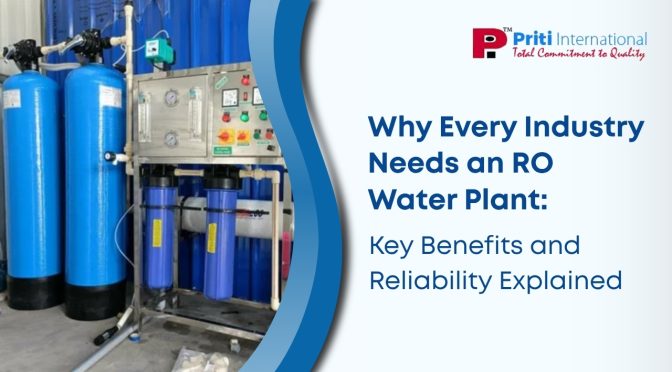
Why Every Industry Needs an RO Water Plant: Key Benefits and Reliability Explained

Water is the backbone of industrial operations – yet it is often the most underestimated resource on the factory floor.

Whether you run a pharmaceutical unit, food processing plant, textile mill or a steel manufacturing facility, the quality of water you use directly affects your product quality, machinery lifespan and operational costs. This is exactly why increasing numbers of industrial decision makers in India and across the globe are investing in a Reverse Osmosis (RO) water plant.

In this blog, we walk you through what a RO water plant does, and why it’s no longer an option for modern industries. Also, what to look for when evaluating RO water plant manufacturers.

What is a RO Water Plant and How does it Work?

A Reverse Osmosis (RO) water plant is an advanced water purification system which forces water under pressure through a semi-permeable membrane. This process removes up to 99% of dissolved salts, heavy metals, bacteria, viruses and other contaminants, delivering purified water suitable for industrial and commercial use.
RO technology is much more sophisticated than just filtration, getting rid of tiny contaminants such as TDS (Total Dissolved Solids), chlorine compounds, fluorides and biological contaminants. This makes it one of the most dependable and complete water treatment solutions available on the market today.

How Industrial Water Quality is a Major Business Issue

According to the World Health Organization (WHO), the global economy loses billions of dollars annually due to filthy water, in terms of lost productivity and equipment damage. Poor water quality in industrial applications results in:

  1. Scaling and corrosion of boilers, cooling towers and pipelines
  2. Contamination of products in the food, drink and pharmaceutical industries
  3. Higher maintenance costs due to mineral deposits in machinery
  4. Not meeting regulatory standards and expensive shutdowns

A well-engineered RO water plant meets each of these challenges directly, making it a smart investment in operations, not just the environment.

Key Benefits of Installing an RO Water Plant in Your Industry

1. Always Superior Water Production
The need for consistency in industrial processes. An RO plant produces water with controlled TDS levels and virtually no microbial contamination – batch after batch, hour after hour.
Such water purity is a prerequisite for the pharmaceutical, semiconductor and beverage industries.

2. Large savings over time
Yes, there is a capital investment to install a RO plant but the long-term ROI is phenomenal. Industries that changed to RO treated water report:

  1. Reduction in the use of chemicals for boiler and cooling tower treatment up to 40–60%
  2. Extended machine life, reduced equipment failure is
  3. Less reliance on expensive packaged or tanker water

And with less downtime and less maintenance, the system pays for itself quicker than most plant managers anticipate.
3. Scalability to Match Your Production Needs
Today RO Water plant manufacturers design systems from small capacity units (500 LPH) to large industrial plants (1,00,000 LPH and above). As your production grows, you can scale up your water treatment system without a complete overhaul.
4. Compliance With Regulatory Standards
In India, industries have to comply with BIS standards, FSSAI guidelines for food and beverages, pollution control board norms. A consistent way to meet these standards is to have a RO plant which will also reduce the risks of penalties, audits and forced shutdowns.
5. Easy Maintenance And Reliability
Modern RO systems are designed for continuous operation — some running 24/7 with minimal human intervention. New systems have automated controls, pressure monitoring and real-time TDS meters that alert operators before problems get out of hand.
The trustworthy RO water plant manufacturers also provide Annual Maintenance Contracts (AMCs) to keep your system in optimum condition all through the year.

The Growing Role of RO Plants in the Packaged Drinking Water Sector

The packaged drinking water market in India is projected to grow at a CAGR of over 20% through 2027, driven by rising health awareness and urbanization.
An RO plant for packaged drinking water is the foundation of this industry. From small mineral water startups to large-scale bottling plants, RO technology ensures the water meets IS 14543 standards — the mandatory BIS certification for packaged drinking water in India.
Manufacturers in this space rely on high-capacity, food-grade RO systems with multi-stage filtration, UV sterilization, and automated CIP (Clean-in-Place) systems to maintain hygiene without halting production.

What to Look for When Choosing RO Water Plant Manufacturers

The choice of the right manufacturer is as important as the choice of the right technology. Experienced plant managers recommend evaluating the following:
Technical Expertise Does the manufacturer offer custom-engineered systems based on your source water analysis and daily volume requirement?
After-Sales Support: Check for manufacturers that have responsive service teams, genuine spare parts, and documented AMC options.
Track Record: Ask for installation references, particularly from industries like yours.
Certifications: Check whether the manufacturer has ISO certifications. Also, check whether food grade or industrial grade membrane is used and from which trusted brand.
Local Presence: Kolkata RO water plant manufacturers offer a distinct advantage to businesses in eastern India through faster installation, quicker service response, and a better understanding of local water quality challenges such as high iron levels and turbidity.

Why Location Matters: The Advantage of Local RO Manufacturers

Partnering with RO water plant manufacturers in Kolkata and nearby areas is not only convenient. Local manufacturers are aware of the challenges of regional water such as high levels of arsenic in the ground water of parts of West Bengal, and can adapt the design of the system accordingly.
They also provide faster site assessments, lower logistics costs for delivering equipment and local service teams that can respond in hours rather than days.
Priti International is one of the trusted names among RO water plant manufacturers in Kolkata, and has been providing customized industrial water treatment solutions for eastern India. Hands on experience in packaged drinking water, pharma , and manufacturing, Priti International combines technical expertise with responsive local support — making them a go-to partner for industries looking to get their water treatment right the first time.

Final Thoughts

An RO water plant is not a luxury, but an operational necessity for any industry that relies on water quality for product integrity, equipment health and regulatory compliance.
With industries across India upgrading their infrastructure, selecting experienced and certified RO Water Plant Manufacturers means you are getting a RO plant that is built to last, designed for your specific conditions and backed long after installation.
If you are looking at options – be it for a new greenfield project, or upgrading an existing system – start with your water quality data, and look for a manufacturer with proven industrial experience. Priti International can help you assess your needs, design the right system, and help you every step of the way during installation and beyond.

FAQ

Q1. How long does an industrial RO plant last?
A well-maintained RO plant can last 10 to 15 years or more. Regular membrane cleaning, timely filter replacement, and periodic system audits significantly extend its operational life.
Q2. What industries benefit the most from RO water plants?
Pharmaceuticals, food and beverages, textiles, power plants, automotive manufacturing, hospitals, and packaged drinking water units all see major operational and cost benefits from RO systems.
Q3. Is an RO plant suitable for high TDS groundwater?
Yes. Industrial RO plants are specifically designed to handle high TDS water (often 1,000–5,000 ppm or more). The system configuration — including pre-treatment stages — is customized based on your source water quality report.
Q4. What is the difference between a commercial and an industrial RO plant?
Commercial RO plants typically serve offices, restaurants, and small institutions (up to a few thousand litres per day). Industrial RO plants are built for large-scale, continuous operations — often processing tens of thousands of litres per hour — with robust components, automation, and higher pressure systems.
Q5. How do I get started with installing an RO plant for my facility?
Begin with a source water analysis to determine TDS, pH, hardness, and microbial load. Share this report with shortlisted RO water plant manufacturers, who can then propose a system design, capacity, and cost estimate tailored to your specific needs.