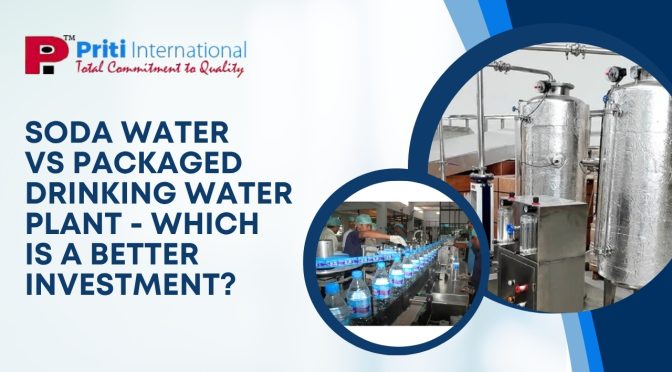
Soda Water vs Packaged Drinking Water Plant – Which Is a Better Investment?

You have the capital. You want to enter the beverage manufacturing space. And now you are stuck between two options — a soda water plant in Kolkata or a packaged drinking water plant.
Both are in demand. Both are profitable. These are not the same investments, however.
Here are some ways to compare.

The Core Difference

A packaged drinking water plant processes, purifies, and bottles plain drinking water — sold under BIS ISI standards (IS 14543). It serves households, offices, institutions, and retail.
A soda water plant (carbonated water plant) pressurizes purified water and introduces CO₂, producing sparkling water or carbonated drinks. It is used for restaurants, hotels, bars and beverage companies.
Different products. Different buyers. Different margins.
Investment Comparison

Factor

Soda Water Plant

Packaged Drinking Water Plant

Setup Cost

₹15 lakh – ₹50 lakh

₹10 lakh – ₹40 lakh

Machinery Complexity

Moderate to High

Low to Moderate

Raw Material

Purified water + CO₂

Source water + chemicals

BIS License Required

Yes

Yes (IS 14543)

Target Market

HoReCa, B2B brands

Retail, institutions, bulk buyers

Competition

Moderate

High

Packaged drinking water plant cost in India is slightly lower to start with the margins being tighter, because there is a lot of competition from the established national brands.

Which of the Two Items Has the Greatest Margin of Profit?

Soda water is a higher price per unit due to the carbonation process and B2B business from hotels and restaurants.However, the volume game in packaged drinking water — especially 20-litre jar segments — can generate steady, recurring revenue once distribution is locked in.
The honest answer: Soda water wins on margins. Packaged water wins on volume and market size.

Which Should You Choose?

Choose a soda water plant in Kolkata if you already have HoReCa contacts or want to supply to beverage companies and avoid the retail distribution battle.
Choose a packaged drinking water plant if you want a larger, more stable market and are ready to compete on distribution and brand building.
Some investors set up both under one roof — sharing the RO purification system and reducing per-unit cost significantly. This is where a turnkey consultant adds real value.

Let Priti International Help You Decide

Since 1985, Priti International has helped entrepreneurs across India set up both soda water and packaged drinking water plants — from concept to commissioning.
We assess your location, budget, and market before recommending the right setup. No guesswork. No one-size-fits-all advice.
Contact us today for a free consultation.

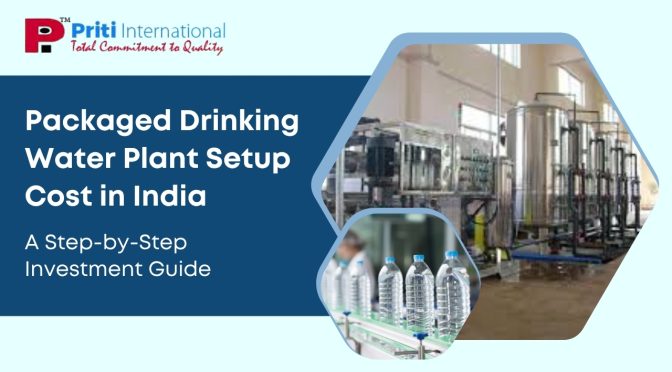
Packaged Drinking Water Plant Setup Cost in India — A Step-by-Step Investment Guide

You have decided to invest in a packaged drinking water plant. The idea makes sense — demand is growing, competition in Tier 2 and Tier 3 cities is still manageable, and the margins are real.
But here is where most first-time investors go wrong — they budget for the machinery and forget everything else.
The packaged drinking water plant setup cost in India is not just one number. It is four phases of investment – and missing even one of them can stall your entire project.
This guide breaks it down phase by phase, so you know exactly what you are paying for and when.

Step 1 – Site & Civil Work

This is where your project actually starts — and where most investors miss the budget.

What is included:

  1. Land leveling, land preparation
  2. Construction of clean room for filling area.
  3. The storage area, utility room, and laboratory, space.
  4. Drainage, plumbing and waterproofing
  5. Electrical wiring, switchgear and back up power configuration.
  6. Hygiene compliant false ceiling and flooring.

Estimated cost:

Setup Type

Civil Work Cost

Rented space (fit-out only)

₹5 lakh – ₹15 lakh

Owned land (full construction)

₹15 lakh – ₹40 lakh

The timeline is a range of 30 – 60 days, depending on the extent of civil work.

Minimum space required: 1,500 – 3,000 sq ft for a small to medium plant.

Step 2 – Machinery & Equipment

This is the biggest single spending on your packaged water plant cost in India. A complete machinery setup consists of:

Machine

Function

Approx. Cost

RO system

Primary water purification

₹2.5 lakh – ₹12 lakh

UV sterilisation unit

Bacteria and virus elimination

₹40,000 – ₹1.5 lakh

Ozone treatment unit

Disinfection and shelf life

₹60,000 – ₹2 lakh

Multi-stage filtration

Sand, carbon, micron filters

₹80,000 – ₹2.5 lakh

Bottle filling & capping machine

24 – 90 BPM

₹3 lakh – ₹18 lakh

Labelling machine

Automatic label application

₹1 lakh – ₹4 lakh

Shrink wrap machine

Carton bundling

₹80,000 – ₹3 lakh

Water testing lab setup

In-house quality control

₹1 lakh – ₹3 lakh

The total machinery cost of an LPH machine of the standard plant is in the range of ₹15 lakh to ₹35 lakh.

When ordering a cooler, a minimum of 30 – 45 days will pass from ordering to delivery and installation.

Step 3 – Licensing & Government Approvals

This is the stage that often catches investors off guard, with both the costs and timeframe being significantly underestimated. In India, it’s mandatory for every packaged drinking water plant to complete this phase before they can start producing water for commercial use.

  1. BIS Certification (IS 14543) — mandatory, ₹50,000 – ₹1.5 lakh, takes 3 – 6 months
  2. FSSAI License — food safety compliance, ₹7,500 – ₹30,000
  3. Pollution Control Board clearance — ₹10,000 – ₹50,000
  4. Groundwater extraction NOC — ₹5,000 – ₹20,000
  5. Factory registration — ₹5,000 – ₹15,000

Total licensing budget: ₹75,000 – ₹2.5 lakh
The process typically takes around 3 to 6 months to complete, with the BIS certification stage being the longest part of it.

Priti International takes care of the entire licensing process for its clients, handling everything from getting documents ready to following up with the government. This helps cut down on delays in getting approvals.

Step 4 – Working Capital & Operations

This is where most new investors get tripped up. There is a need to have working capital to operate your plant until the revenue stabilises, which is 3 – 4 months after commissioning the plant.

The monthly operating expenses to plan for:

  1. Packaging material (bottles, caps, labels, cartons) — ₹50,000 – ₹2 lakh
  2. Electricity (RO + machinery + lighting) — ₹25,000 – ₹80,000
  3. Manpower (5 – 12 staff) — ₹60,000 – ₹2 lakh
  4. Raw water supply — ₹5,000 – ₹20,000
  5. Distribution and transport — ₹20,000 – ₹60,000

Recommended working capital reserve: ₹3 lakh – ₹8 lakh for the first 3 months

Hidden Costs Most Investors Miss

These are real costs that rarely appear in a basic project quote — but every experienced consultant knows them:

  1. Brand trademark registration — ₹4,500 – ₹9,000
  2. BIS lab testing fees — ₹30,000 – ₹80,000 (paid separately during certification)
  3. Consultant or project management fee — 3% – 8% of total project cost
  4. Generator or power backup — ₹1.5 lakh – ₹5 lakh depending on load
  5. Transportation of machinery — ₹50,000 – ₹2 lakh depending on distance
  6. Staff recruitment and training — ₹30,000 – ₹1 lakh

Complete Packaged Drinking Water Plant Cost in India – Summary


Phase

Investment Range

Phase 1 — Civil & site work

₹5 lakh – ₹40 lakh

Phase 2 — Machinery & equipment

₹15 lakh – ₹35 lakh

Phase 3 — Licensing & approvals

₹75,000 – ₹2.5 lakh

Phase 4 — Working capital (3 months)

₹3 lakh – ₹8 lakh

Total estimated investment

₹25 lakh – ₹90 lakh

How Priti International Helps You Plan the Right Budget

At Priti International, we have seen what happens when investors plan only for Phase 2 and forget the rest. Projects stall, timelines extend, and additional funds are needed at the worst possible moment.
Our turnkey consultancy service covers all four phases under one contract — so your entire packaged drinking water plant setup cost in India is planned, documented, and executed without surprises.

As an ISO 9001:2015 and ISO 14001:2015 certified project consultant based in Kolkata, we have successfully commissioned plants across West Bengal, Bihar, Assam, Jharkhand, and internationally in Nepal, Bhutan, and Bangladesh.

Get Your Free Phase-Wise Cost Estimate.

FAQ’s

Q1. What is the total packaged drinking water plant setup cost in India for a small plant?

For a small plant that produces 500 to 1,000 liters per hour, the total cost to set it up is usually between ₹25 lakh and ₹45 lakh. This includes the cost of civil work, machinery, licensing, and the money needed to get the plant up and running.

Q2. Which phase takes the longest time?

Getting the necessary licenses is a big part of any project, and it can take a while. Usually, it’s the BIS certification that takes the longest, around 3 to 6 months. But the good thing is that you can do other things at the same time, like civil work and installing machinery, to save time overall.

Q3. Is a turnkey consultant worth the fee?

Hiring a good consultant can be a big help. They can make sure you don’t pay too much for equipment and that you follow all the rules from the start. This can save you a lot of time and money in the long run. A consultant like Priti International can help you get everything done on time and within budget. The money you save will be more than what you pay for their services.

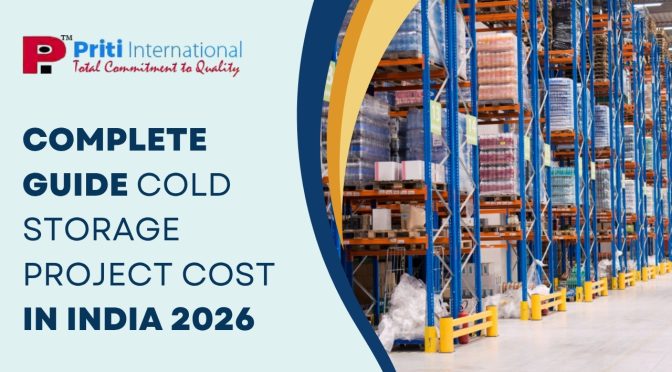
Cold Storage Project Cost in India 2026 — Complete Investment Guide

Nearly 30% of the agricultural produce is wasted in India on an annual basis due to the lack of proper storage infrastructure.
That’s not a problem for investors. That’s a chance!
At this time, one of the most stable and profitable industrial investments in India is cold storage.
Demand is expanding in agriculture, dairy, pharmaceuticals and food processing, while supply is still trying to catch up in Tier 2 and Tier 3 cities.

The first question you should ask when considering a cold storage project is – What is it going to cost?

This blog gives you real figures of the cold storage project cost guide, no guesswork.

What Affects The Cost of a Cold Storage Project in India?

Before looking at numbers, understand what drives the investment:
Storage Capacity —  The capacity of the storage facility is one factor. This is measured in tonnes. A larger capacity means costs for construction and machinery.

Type of Product Stored — The type of product being stored is another factor. Fruits and vegetables require a different temperature than dairy products or pharmaceuticals

Location —  The location of one of the facilities is also important. The cost of land, power and construction varies from state to state.

Technology Level — The level of technology used is another factor. Traditional systems are cheaper to set up. Modern energy-efficient systems can save you money in the long run.

Government Subsidies —Government subsidies can also reduce your investment. The National Horticulture Mission and the National Bank for Agriculture and Rural Development offer subsidies that can help.

Capacity-Wise Cold Storage Project Cost (5 MT to 500 MT)

Capacity

Type

Estimated Total Investment

5 MT – 20 MT

Small scale

₹8 lakh – ₹25 lakh

25 MT – 50 MT

Small to medium

₹25 lakh – ₹60 lakh

100 MT – 150 MT

Medium scale

₹70 lakh – ₹1.2 crore

200 MT – 300 MT

Large scale

₹1.3 crore – ₹2.2 crore

400 MT – 500 MT

Industrial scale

₹2.5 crore – ₹4 crore+

Type-Wise Cost Breakdown

Various products demand various temperature ranges and this makes a difference to your machinery and insulation cost:

  • Fruits & vegetables: 0°C to 8°C — most common setup, moderate insulation cost.
  • Dairy & milk products: 2°C to 4°C — needs accurate temperature control systems.
  • Frozen food & meat: 0°C to +4°C — the next most expensive.Dairy products, cooked food, and eggs.
  • Pharmaceuticals & vaccines: 2°C to 8°C – requires validated and precision controlled environment.
  • Flowers & nursery products: 4°C — moderate setup, high demand in urban markets.

Government Subsidy Schemes You Must Know

This is the place where lots of investors miss out on money. There are two important schemes that can help you save a lot on your cold storage project cost in India

NHM — National Horticulture Mission

  • Subsidy: up to 35% of the project cost
  • Awarded to: fruits, vegetables and flower storage projects
  • Implements through: State Horticulture Departments

NABARD — National Bank for Agriculture and Rural Development

  • Provides back-ended capital subsidy for cold chain infrastructure
  • Eligible projects: cold storage, refrigerated transport, pack houses
  • Loan support available through NABARD-linked banks

To get these subsidies you need to have documentation and project reports from the beginning. Priti International can help you prepare these reports and get the subsidies you’re eligible for.

Monthly Operational Cost Estimate

Expense

Monthly Estimate

Electricity (refrigeration + lighting) ₹30,000 – ₹2 lakh
Manpower (3–10 staff) ₹40,000 – ₹1.5 lakh
Maintenance & spare parts ₹10,000 – ₹40,000
Insurance ₹5,000 – ₹20,000
Miscellaneous ₹5,000 – ₹15,000

Total monthly operating cost (100 MT plant): approximately ₹1 lakh – ₹3.5 lakh

ROI Timeline – When Will You Break Even?

  • Break-even period: 3 – 5 years for a medium to large scale cold storage
  • Business model: Monthly rental fees per MT (generally ranging from ₹150 – ₹500 per MT per month based on product and location)
  • Revenue potential: ₹3 lakh – ₹10 lakh per month when the plant is 200 MT.
  • Key advantage: There is a high occupancy rate in cold storage in Tier 2 cities and agricultural belts during the harvest seasons, resulting in high seasonal revenue.

Why Choose Priti International for Your Cold Storage Project?

We don’t just provide refrigeration equipment at Priti International, we provide a complete refrigeration facility ready to operate.
We offer end-to-end turnkey solutions with:

  • Site assessment and capacity planning
  • Civil and structural design
  • Refrigeration plant procurement and installation
  • Insulation panel and rack system setup
  • Electrical and temperature control systems
  • Subsidy documentation and government approvals
  • Staff training and post-setup support

We are an ISO 9001:2015 and ISO 14001:2015 Certified turnkey project consultant from Kolkata and have completed cold storage and food processing projects in West Bengal, Bihar, Assam and beyond.

Get a Free Cold Storage Project Cost Estimate.

FAQs

Q1. What is the minimum investment to start a cold storage business in India?

A: A scale cold storage unit of 5-20 metric tonnes requires a minimum investment of ₹8 lakh to ₹25 lakh depending on the location, product type and technology used.

Q2. Can I get a government subsidy for my cold storage project?

A: Yes. Both the National Horticulture Mission and the National Bank for Agriculture and Rural Development offer subsidies of up to 35% of the project cost for cold storage projects.

Q3. How long does it take to set up a cold storage plant?

A: A scale cold storage project of 100-200 metric tonnes typically takes 3-5 months from order confirmation, to commissioning depending on the progress of civil work and equipment availability.