Most businesses ask this question the wrong way. They treat ETP, STP and ZLD as three competing products and assume the job is to pick the best one. It isn’t. These three aren’t rivals on a shortlist — they do different jobs, and many industrial sites are legally required to run more than one of them at the same time.
So the useful question isn’t “which is best?” It’s “which combination does my Pollution Control Board consent actually demand?” Here’s how to answer that clearly.
The 30-Second Difference
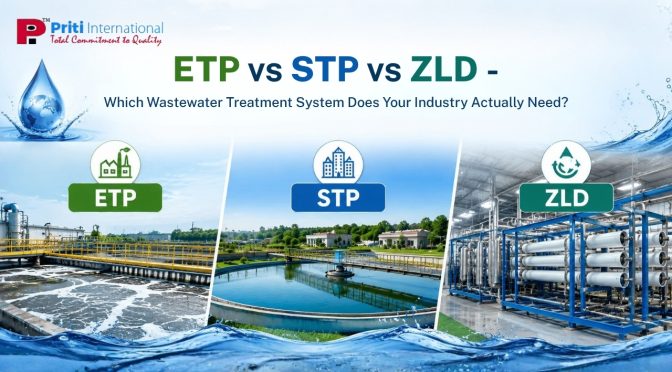
STP — Sewage Treatment Plant. Treats domestic wastewater: toilets, kitchens, washrooms, canteens. The pollutants are organic — human waste, food matter, detergents. Any facility with people generates sewage, so offices, hotels, hospitals, housing societies and factory washrooms all produce it.
ETP — Effluent Treatment Plant. Treats industrial wastewater from your manufacturing process — chemicals, dyes, oils, heavy metals, high COD and TDS. This is the dangerous stream, and it varies wildly by industry. A dairy’s effluent looks nothing like a tannery’s.
ZLD — Zero Liquid Discharge. Not a separate “plant” so much as an outcome. ZLD is an advanced stage bolted onto an ETP that recovers up to 95% of your water and discharges nothing liquid at all, leaving only solid salts. It uses RO, evaporators and crystallisers to close the loop.
The key insight: STP and ETP are defined by what they treat. ZLD is defined by how completely you treat it. That’s why “ETP vs ZLD” is a false comparison — ZLD sits on top of an ETP, it doesn’t replace it.
Why Most Sites Need a Combination
A textile dyeing unit is the clearest example. Its workers use washrooms (needs an STP), its dyeing baths produce chemical effluent (needs an ETP), and because dyeing is a red-category, high-pollution activity, the regulator mandates ZLD on top. That’s all three — not a choice between them.
This is the trap behind the “vs” framing. Pick only one when your consent requires two, and you face the real consequences: rejected Consent to Operate, daily penalties, and in serious cases a forced shutdown. The system you “need” is whatever keeps your CTO valid — and that’s decided by the Pollution Control Board, not by preference.
Which Does Your Industry Actually Need?
Here’s a practical mapping. Confirm specifics with your State Pollution Control Board, since norms vary by state and location.
You mainly need an STP if: you run a commercial building, IT park, hotel, hospital, school or residential township, and your wastewater is essentially domestic. Increasingly, new projects of almost any kind must show an STP and a water-reuse plan just to get environmental clearance — so even non-industrial developments are now in scope.
You need an ETP if: you run any manufacturing that discharges process wastewater — food and dairy, beverages, chemicals, pharmaceuticals, textiles, engineering, electroplating, automobile units. The design depends entirely on your effluent profile; a food plant needs biological treatment, while an electroplating unit needs heavy-metal precipitation. Installing a compliant ETP typically runs ₹10–50 lakh depending on flow volume and industry type.
You need ETP + ZLD if: you fall into a sector the CPCB has flagged for zero discharge — textile dyeing, tanneries, distilleries, pulp & paper, and several pharmaceutical and chemical clusters. ZLD is not a blanket rule for all industries, but for these red-category sectors it’s moving from “recommended” to non-negotiable. Distilleries face especially strict rules: spent wash has extremely high BOD, and direct discharge is prohibited regardless of dilution.
If you’re a low-pollution industry not on the ZLD list, a well-designed conventional ETP is usually sufficient. Don’t let anyone upsell you a ₹2-crore evaporator you aren’t required to run.
What ZLD Really Costs – And Why It’s Not Just a Burden
ZLD is the expensive one: typically four to five times the cost of conventional treatment, with payback usually in the 3–5 year range. That sounds painful until you weigh what it returns. A ZLD plant recovers most of your process water, which is a genuine water-security asset in scarce regions; it produces recoverable salts that can sometimes be sold; and crucially, it gives you regulatory peace of mind plus a “green” credential that EU and US buyers increasingly demand in supply-chain audits.
The 2026 direction is unambiguous. New CPCB effluent norms have tightened BOD, COD and TSS limits, online monitoring (OCEMS) is mandatory for red-category units, and frameworks like the Draft Liquid Waste Management Rules and Extended User Responsibility are pushing bulk water users toward water neutrality. ZLD is the most direct route to that status.
One costly mistake to avoid: feeding raw ETP output straight into an RO unit. Conventional ETP effluent shreds RO membranes, which is where many ZLD projects quietly fail or become unaffordable to run. Stream segregation — treating low-TDS water cheaply and reserving expensive thermal evaporation for the concentrated 30% — is what keeps ZLD economics sane. Good design here saves more money than any single piece of equipment.
Choosing the Right ETP Plant Manufacturer
This is where the decision is won or lost. The biggest reason treatment projects fail isn’t regulation — it’s poor design data. A serious ETP plant manufacturer won’t quote you a system from a single grab sample; they’ll run a proper effluent audit, design around your actual ion profile and flow, and size the plant to your CTO conditions rather than a generic template.
At Priti International, we engineer and install ETP, STP, ZLD, RO and DM plants across Kolkata and Eastern India — built around your specific effluent, your industry’s CPCB norms, and your consent requirements. If you’re unsure which combination your site actually needs, that’s exactly the question we’ll answer before recommending a single piece of equipment.Explore our ETP, STP, ZLD & RO solutions ortalk to our team for a site-specific assessment.
FAQ
Can one plant handle both sewage and industrial effluent?
No. Domestic sewage and industrial effluent have different pollutant profiles and usually require separate STP and ETP systems, though both can sit within one facility.
Is ZLD mandatory for my industry?
Only for specific high-pollution sectors flagged by the CPCB/SPCB — textiles dyeing, tanneries, distilleries, pulp & paper and parts of pharma. Many industries comply fully with a conventional ETP. Confirm with your State board.
How much does an ETP cost?
Roughly ₹10–50 lakh depending on flow volume, industry and effluent complexity. A site-specific audit gives a real figure.